Home » Flyer with lipstick
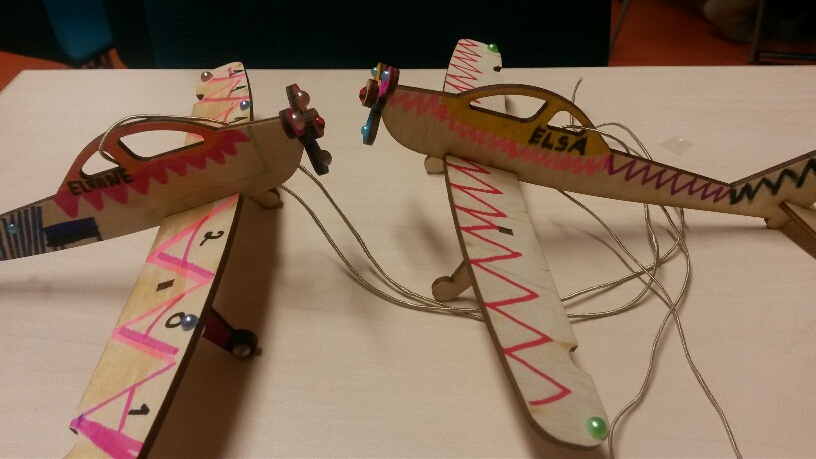
In a school in Tallinn last week, we made planes with the children and their fathers. The twin girls named their planes Elsa and Elviine. I thought they were girls’ names, but it turned out that Elsa and Elviine were the first female pilots in Estonia. A few days later, I started researching the matter and discovered a fascinating story about Elviine Kaalep, who was indeed one of the first female pilots. A girl from Nõmme, Tallinn, with an incredibly exciting life story. Her story was published in the magazine Kultuur ja Elu 2/2005, and we decided to bring it to you on our blog.
Have fun reading with your children!
Culture and Life magazine 2/2005
WRITER: HEIKI RAUDLA
When Heiki Raudla read Anto Juske’s story about Estonia’s first female pilot Elviine Kalep in Sakala in January 2005, he remembered that there was something about her somewhere in the archives at home. While browsing through the material, he became interested in finding out more, and so the story of a woman who went by the name of Alviine or Elviine Kalep (Kaalep) in Estonia and Elvy Kalep abroad was put down on paper.
As the church records show, Alviine (Alwine)-Johanna Kalep (Kaalep) was born in Pärnumaa, Tori parish, Taali parish on 26 June 1899 (dd). Her father Aksel (Axel) Emil (b. 9.03.1875) was from Jäneda and was a locksmith, her mother Joanna (b. Liidemann) was born in Tori parish on 28 April 1979. Aksel and Joanna married on 6 September 1898.
Elvy was the only child of the family. Records of her long and complicated life, full of legends, were not easy to find and some are contradictory. Moreover, some of the facts come from the press, and in many cases the question arises as to where there is truth and where there is not.
1971. In 2008, a long story about Elvy Kalep appeared in the Florida newspaper The Naples Daily News. It says that she was barely a year old when both her parents died. Kristin’s relatives, who lived on Tähe Street in Nõmme, Tallinn, adopted her into their family. She was a talented girl, but of a restless nature. Even as a small child, she ran away from home to the wide world. However, she was caught at the Baltic station. At the age of eight, she took up drawing and cartooning. After completing her primary education, Elvy went to Tallinn Girls’ Commercial Gymnasium. There, the teachers noticed her bohemian nature and talent, and thought that she would be the talk of the town one day.
In 1916, Elvy was sent away from the war, first to Narva, then to St Petersburg, but it was there that she was caught up in the revolution. Kalep later described his experience of the revolution as follows. On the other side of the river, on the bank of the river, we were watching a parade of people on the riverbank. To get a closer view, we both climbed the rampart that bordered the bridge and from there we saw the beginning of the revolution. At the end of the bridge there was a large, unruly crowd, a line of soldiers moving, armed cavalry policemen and Cossacks armed with spears and swords. It was the latter who rode back and forth energetically and proved to be the most active in the task of keeping order.
Somehow, one of the horses backed up against a lamppost and stumbled to the ground with its rider. The man crashed into the kerb and his rifle went off. Hardly had the accidental bang sounded when the crowd literally went mad, apparently thinking that the horseman had fired on the crowd. A half-naked man lying in the street was then attacked and the man was literally mauled to death.”
The following night, riots broke out on a wider scale and terror, brutality and hunger set in. As Elvy happened to be a witness to the events, he had to spend the night in a police detention centre.
It took nearly eight years before Elvy was able to get out of revolution-hit Russia.
Initially, though, all those who had expressed a desire to escape the revolution were ordered to spend the night in a railway station. More than 20,000 of them gathered there. But it took another month or so before they could move. The evacuation, however, did not take place westwards towards Estonia, but eastwards. One of the reasons for this was that Elvy and his step-aunt were supposed to have a brother somewhere near Vladivostok. They were in for trouble near Lake Baikal. A train was sent back from the district a total of eight times, and it was only on the ninth occasion that the fugitives escaped.
Having finally reached Vladivostok, it turned out that their relative had left for China. In Vladivostok, Elvy met a Russian general, Count Slashchov. The young couple fell in love, then married, and a son was born to them. In the Far East, Elvy managed to graduate from the local commercial gymnasium. After several attempts to reach Estonia across Siberia and returning from the borders of the Urals, they decided to flee to China, where the Russian general had connections with the Chinese ruler Chang Tso-Lin. In the outbreak of revolution and civil war, the family fled to China, leaving their fortune behind.
Their first refuge was found in Harbin. The child could not withstand the deprivation and died at one year old. In the ensuing confusion, the husband went missing a year later. However, her language skills saved Elvy, and she was employed as a translator. Thanks to her talent and good language skills (Russian, German, English, and Chinese), she initially found work as a translator for a British general in Mukden (Shenyang). The general had large arms depots in Mukden.
Civil war had also broken out in China, and the warring generals needed weapons. The ruler of North China, Marshal Chang Tso-Lin (1873-1928), saw that such a private secretary would be useful to him. His offers exceeded those of the Englishman, and Elvy became a private secretary to the powerful marshal, and later to the latter’s son Chang Hsüeh-liang or Zhang Xueling (1898 or 1901-2001).
However, for some reason, Elvy was drawn towards aviation. 1924. In 1924, the first flight in an English Bristol Fighter aircraft (one of the most prominent military aircraft in World War I) was supposed to take place in China. When the plane crashed a few hours before the scheduled flight during a test flight by a Chinese pilot, Elvy decided that if flying was still so dangerous, it was wise to wait. She later justified her interest in aviation and technology by saying that she was her parents’ only child and her father tried to raise her as a boy, while her mother tried to raise her as a girl. In fact, she was already interested in flying while studying at the commercial gymnasium in the Far East. Later, in 1950, she justified it as follows: “To fully partake in life and the time in which a person lives. For thousands of years, people have longed to fly and haven’t been able to. Now suddenly it is possible, and why not try to join in.”
Her credo seemed to be an African proverb: life must be taken with a large spoon.
1925. In 1925, Chang Hsüeh-liang sent his secretary to Europe for a holiday. But Elvy was fed up with life among the slant-eyed Chinese. She finally reached Tallinn in 1926 via a rather complicated route (through Sumatra, Italy, and France) with her aunt. She stayed with her foster parents for a while and then moved to Paris. In Paris, the beautiful and energetic woman began studying oil painting with the famous portraitist Alexander Yakovlev, practiced bobsleighing in Switzerland in the winters (where she even once won a championship title), and car racing.
When she visited her foster parents again two years later, she had already made a new career in the meantime. She had married Baron Rolf von Hoeningen-Bergendorff in Paris and obtained Austrian citizenship. Her husband was very wealthy and probably German or Austrian by nationality.
In the winter resort of St. Moritz, Switzerland, the famous Dutch aircraft designer Anthony Fokker (1890-1939) saw Elvy’s virtuoso skiing and suggested she learn to fly. (According to other sources, Fokker’s eye had already caught the energetic and diligent female student during flight lessons, whose courage and perseverance he liked). Elvy’s studies were not even hindered by the fact that she had broken her right arm in a sledding accident in the winter of 1931. Fokker, for his part, gave the young woman encouragement to fly and treated her as his favorite student, resulting in Elvy passing the necessary exams on August 1, 1931, after only five flight hours (which was the required minimum at the time. – H.R.) and becoming the first Estonian woman to receive a professional pilot’s license (no. 369, she was the seventh licensed female pilot in Germany). At the same time, she also learned about aircraft engines and could soon freely act as a mechanic. “I flew a Klemm-Mercedes at the time (specifically a Klemm L2bIIc (D-1132)) and could take apart and put back together my plane’s engine in my sleep,” Kalep confirmed in an interview given in 1971.
While in Germany in 1931, she performed flights in the airspace of North Africa, Asia, and Europe. She mentioned in a later interview: “Suddenly the longing for my homeland proved so inviting that I couldn’t do otherwise and decided to visit Estonia.” In August of the same year, Elvy Kalep, with mechanic Valter Mayer, began a flight in a Klemm sports plane (the plane’s name came from the name of the designer-engineer Hans Klemm) on the route Berlin-Stettin (Szczecin)-Danzig (Gdansk)-Kaunas-Miitavi (Jelgava)-Riga-Tallinn. Already at the beginning of the flight near Stettin, the plane encountered a thunderstorm and rain zone and had to land there. Kalep experienced emergency landings later as well. Near Miitavi, she reportedly got lost in a thunderstorm and again had to make an emergency landing. This time, the plane’s propeller broke during landing. Curious Latvian peasants found Elvy sitting under the wing of the plane with a mirror and lipstick after the emergency landing. Elvy’s flight luggage was very sparse: a toothbrush and a few other essential trifles. It was probably for this reason that European journalists called her the pilot with lipstick. She flew from Riga to Tallinn in one hour and 50 minutes and arrived at Ülemiste airfield on August 18, 1931, at 6:50 PM. There, welcomers and journalists were waiting for her.
The newspaper Oma Maa wrote on August 20, 1931: “The aircraft was a two-seater Klemm type, manufactured at the Ford factory. Such planes can be steered from both sides. With this plane, she performed flight exercises under the guidance of well-known pilots in England. Upon landing, a young man, a German (Valter Mayer – H.R.), sat in the pilot’s seat. The famous female pilot was met at the airfield by aviation officials and a number of air force officers with their wives. There were few other private individuals at the reception. Red flowers were presented to the female pilot. Mrs. Kaalep herself immediately drove to Nõmme, where her relatives lived. From Estonia, Mrs. Kaalep wants to fly to Finland and from there to Brazil, to carry out a circular flight with some other pilots and, if possible, penetrate unexplored areas in the Brazilian jungles.” In Tallinn, Elvy visited her foster parents. She also managed to visit Mari Raamot, the chairwoman of the Estonian Women’s Voluntary Defense Organization, who gave her the organization’s badge, as well as the Minister of Transport, the Minister of Defense, and the commander of the Defense League. 19. On August 25, she began her return flight from Tallinn to be in Amsterdam on September 2 on a ship, from where she was to travel on to South America. Upon leaving, Kalep was melancholy because this time there was no crowd to see her off.”
On the return flight, Elvy was so captivated by the beauty of her homeland that she decided to land on the lands of Sagevere farm near Võhma (current territory of Kabala parish). The plane’s landing instantly set the whole neighborhood buzzing. Hundreds of curious people from Võhma borough and Ollepa, and even from more distant villages, came to see the rare steel bird and its pilot. Elvy was shown local sights, given smoked ham at the Võhma Export Slaughterhouse, and butter at the dairy association. In the evening, the chief of the Pilistvere squadron, the chairman of the Võhma volunteer fire brigade, representatives of the Women’s Voluntary Defense Organization, and other social organizations came to greet the brave female pilot. The female pilot was also very well received at Tõnu farm in the family of Doctor Hans Männik. For the night, the plane was placed in a hay barn guarded by members of the Defense League. Elvy continued her flight towards Riga from the lands of Tõnu farm the next morning. This time, a large crowd was seeing her off.
Arnold Sepp, a journalist for Sakala at the time, recalled this day in his book “Mu meelen” as follows: “The telephone on the wall rang and Männik, the doctor of the Võhma district, explained in an excited tone that the famous female pilot Elvy Kalep, who is currently performing a world flight, landed in the meadow behind his barn. Fly over here! But there was no boastful phrasing in the last sentence, because we there at the Viljandi airfield always had a Klemm-Hirth monoplane sports plane ready to fly, and my pilot friend Ulrich Brasche lived just halfway between Sakala and the airfield.
We immediately informed Brasche of the story, who of course was extremely fired up, and less than an hour after the call, we too landed next to Elvy Kalep’s plane behind Männik’s barn. More accurately, Elvy’s plane had already been pushed into the barn and the greeting took place at the barn gate. In the grain barn, Kalep’s plane with folded wings resembled a sleeping butterfly. Kalep surprised us with excellent Estonian. As if by an irony of fate, the Reds built an airfield on that farm’s land in 1940-1941.”
Arnold Sepp recalled Kalep many years later in the newspaper Vaba Eesti Sõna: “Exactly twenty-five years from the day those certain planes landed behind Männik’s barn in Võhma, a ‘familiar woman’ stepped into the Miami Estonian House for a reception, accompanied by a former Estonian airman, August Mihk, who had already been living in Miami for a long time. The latter began to introduce the lady, but we were already looking each other in the eye, thinking there was no need for introductions, we were already acquainted. A warm greeting ensued, and stories flowed abundantly about flights and the Võhma area. The flying lady had lost none of her youthful charm, nor her fluent Estonian.
What I particularly remember from this second meeting and conversation was Elvy Kalep’s spirited story of how the bigwigs of the Võhma Export Slaughterhouse had given her a large smoked ham upon her departure. Later somewhere in Europe, the flying Elvy became a bit short on funds and the plane had to be sold to get back to America by ship. ‘But that smoked ham, I wouldn’t have sold that for any price!’ the lady confirmed with sparkling eyes. ‘I didn’t even have the heart to eat it properly, even though I was quite hungry. It smelled so lovely of a familiar Estonian farmhouse that the plane could go before that Võhma ham. So I brought the ham to America with me, and only here, on the occasion of festive gatherings, did it begin its natural shrinking until it finally ran out somewhere around Chicago.’”
The move to the American continent was delayed. 1931. In 1932, the young female pilot sold her plane to the Shell oil company and traveled to the Netherlands. 1932. In 1932, she got to know a prototype of a helicopter, the so-called autogyro, in London. 10. On May 31, 1932, Elvy arrived in New York from France on the steamer “Paris”.
In America, Elvy became friends with the famous female pilot Amelia Earhart (1897-1937), who had already flown across the Atlantic Ocean in 1928 with Slim Gordon and Wilmar Stultz. She also became well acquainted with pilot Wiley Post (1899-1935), who died in a plane crash with his friend, humorist Will Rogers, in 1935 near Alaska. Will Rogers’ witty aphorism: “Better a horrible end than a horror without end” proved correct for himself this time. Post had made his first solo flight around the world in 1933 in 7 days and 18 hours.
On May 21, 1932, Estonian world travelers, pilot Elvy Kalep and ocean sailor Ahto Valter with his brother Jariilo, met at a tribute evening at the New York Estonian Educational Society house. They had once again crossed the Atlantic Ocean. Perhaps it was there that Elvy had the idea to cross the Atlantic Ocean by plane. 1932. In 1932, she made serious preparations in New York for an attempt to be the first woman to cross the Atlantic Ocean alone. When her friend Earhart secretly completed her preparations three days earlier and was the first to fly across the Atlantic in May 1932 in 14 hours and 56 minutes, Elvy Kalep decided that there was no point in repeating the undertaking as the second woman. Nevertheless, she joined 99 women interested in aviation in America who had founded the female pilots’ organization “Ninety-Nines” in 1929 (named after the number of its founding members), of which Amelia Earhart was the first president. Today, it is an international organization with nearly 6,500 female pilots from 35 countries around the world.
Kalep planned to perform another major ocean flight. 15. On August 29, she was supposed to start from Los Angeles to Athens with pilot Roger Q. Williams (1895-1976) in honor of the Olympic Games. Initially, she planned to travel to Estonia but found no sponsors. All the major American newspapers wrote about the intended sensational trip, but then it turned out that the trip was canceled. Instead, the newspapers reported that Elvy Kalep had married stockbroker W. E. Hutton-Miller, who was categorically against the trip.
In Estonia, for some reason, it was thought that Kalep was a millionaire, and she began receiving letters from people asking for help. The letters were sent to the New York airport and arrived. Elvy found that “such assistance is harmful because it morally ruins a person. A person must manage their own life.” She remained true to this principle even when she later needed help herself.
At that time, flying was very dangerous despite everything. Thus, between 1919 and 1930, 28 people died in attempts to fly across the Atlantic. In 1931, Earhart tried to fly across America in a helicopter, but it was not successful. 1937. In 1937, Earhart, who had set dozens of records, tried to fly around the world along the equator but went missing over the Pacific Ocean in early July with navigator Fred Noonan. There are several legends about her disappearance, and the exact place of death is also unknown. Before her last takeoff, Amelia Earhart wrote the following prophetic lines to her husband, publisher George P. Putnam: “Please understand that I know perfectly well what I am risking. I am doing it simply because I want to. Women must also try to do something like men. And if they fail, the failed attempt will be a challenge to others.”
Elvy Kalep was probably motivated by the same thoughts.
Instead of flying, Elvy Kalep began giving lectures about Estonia and aviation. 1970. In the early 1970s, she recalled: “I spoke to Americans about everything, and when they asked what the Estonian language sounds like, I always declaimed the first verse of ‘Kui Kungla rahvas kuldsel aal…’, which in my opinion best characterizes the beauty of the Estonian language. The Americans were delighted by it.” As an indirect fruit of the lectures, her first children’s book “Air Babies” (Õhubeebid or Lendurlapsed – H.R.) was born in 1936, where the main characters are sister and brother Speedy and Happy Wings, and which she illustrated herself. Regarding her book, Elvy Kalep later mentioned that she wrote it with the aim of eliminating prejudices and fear of flying in young people and especially in parents who hold young people back. For some reason, she was not satisfied with the drawings in her book and terminated the contract with the publisher after all 100,000 books had been sold. 1938. In 1938, the second edition of the book appeared, and in 2003, the third. The characters created by Kalep were so popular in America that wallpapers were even made after them. Even today, one can find offers and requests to acquire this book on the internet.
In the foreword, her friend Amelia Earhart wrote, among other things: “When I recently reviewed aviation literature for children, I found that unfortunately very little has been written for the young. Anyone who has worked in the industry knows that of the entire population, it is the youth groups that are very important when it comes to planes and air travel. I hope that ‘Air Babies’ and children become good friends.”
1939. The Second World War, which began in 1939, put an end to receiving certain support from Europe; also, the marriage to the stockbroker had ended, and since Kalep had only 57 dollars in her wallet on September 3, the day England declared war on Germany, she had to start looking for a more permanent income. The idea of offering children something related to the era of air conquest was appealing, and so Kalep brought Patsie Parachute (a doll-parachutist) to the American toy market – a doll with a small parachute that fell beautifully and gracefully when thrown into the air.
This was the start of Kalep’s new field of activity, which made her famous in New York. She commented on it quite modestly herself: “I think up nonsense and take patents for them and give them to industrialists or produce them myself. Has more money been spent on anything else in the world than on pleasant nonsense?”
However, the factory near New York, which employed 60 women, did not yield a large profit. Since men were not available for industry during the war, the energetic manufacturer had to carry heavy boxes herself. Due to the overwhelming work, Kalep fell ill, and the doctor forbade her from lifting heavy packages. Finally, she had to close the doll factory in 1946. The manufacturer herself had to set about recovering and healing her overstrained health. All the money earned was spent on health insurance. 1950. By 1950, she had recovered again and was thinking up new things, taking patents for them, and sending them to thousands of businesses. Among the latter was New York’s largest children’s toy store, F. A. O. Schwarz on Fifth Avenue, one of whose display windows was completely decorated with Elvy Kalep’s new dolls, the so-called Scribbles dolls, whose face every child can draw themselves and redo if necessary.
How the invention of this new bestseller doll came about, Kalep recounted in 1950 as follows: “After the doll factory closed, nearly 50,000 doll heads were left over. I started drawing faces on them to pass the time. Due to a slip of the pencil, I started erasing the drawing from one face, and suddenly the idea flashed through my head: why not let the children do it themselves. And now they can do it. With the doll, every child gets 5 chalk pencils, an erasing cloth, and a ‘study book’ from the store. With these instruments, every child can give their doll’s face 1,000 different expressions.”
Elvy Kalep is again in full creative and working swing. Her dolls are in the spring catalog of the popular firm Schwarz. Her pace of life is frantic, interspersed with interviews for newspapers, radio, and television. The energetic lady already had the establishment of a new factory in mind. However, nothing came of the latter.
In the following years, little is heard of her. Thus, it is not even known exactly when Kalep stopped flying. Nevertheless, her tracks did not disappear completely.
1971. In 1971, a long story about female pilot Elvy Kalep appeared in the newspaper “The Arlington News.” In the same year, a piece about her by Pedro Krusten also appeared in the newspaper Vaba Eesti Sõna. We learn that she still does not seek help from social welfare but is proud and independent. While living in California in 1960, it happened that acquaintances gave her five pieces of leather, all of different colors. They added that she was a clever woman and perhaps she could make something out of them. Maybe even eyeglass cases. Elvy initially put the pieces of leather under the bed because making eyeglass cases did not interest her. In a half-sleep, however, a colorful mosaic rose before her eyes: a Mexican, a cactus… The next morning, she got a piece of cardboard and glue from someone, and the night vision became a reality. She liked the picture and decided to start earning a living with her new hobby. She improved herself for a whole year and then took a patent for her invention.
In 1967, she still did not have a home; she traveled around America, exhibiting her works in expensive clubs, as experience showed that she could only find buyers for her work among the wealthy. In Pedro Krusten’s story, one can read: “Things did not go well for her at the Arlington library. She canceled the announced courses because there was no interest in them. Together we took her pictures from the glass display case and carried them out to where her station wagon stood. In the large vehicle, there was room for only herself to sit. The entire rest of the space was taken up by her belongings, which were under rugs. Mainly pictures. She brought out a large dragon from there. ‘My fifth such work,’ she said. ‘The first four have found a buyer after all. The price is two thousand dollars.’ Made of pieces of lizard and snake skin. Very beautiful colors. She orders the skins from Europe. ‘I am like a gypsy,’ she says, starting the car. ‘A lone wolf,’ I thought, ‘proud and independent.’”
Due to deteriorating health, she moved to the Regency Health Care Center (a so-called hotel for retirees) in November 1986. In the last decades, she had no contact with her compatriots, although she considered herself a good Estonian. Elvy Kalep died in Lake Worth (Palm Beach, Florida) on August 15, 1989. She had no relatives in the USA. She was buried alone, forgotten, but in the hope that perhaps one day she would be remembered in her homeland, Estonia.