Who among us doesn’t remember the marzipan figurines from our childhood that stood in a display case and were never eaten. Some, of course, had tooth marks on the back because it was quite hard not to nibble on something sweet. I had a colorful rooster, a hen, and a kitten standing on top of my cupboard. I still had that kitten from my childhood just a few years ago, and it was great to show children in workshops that marzipan never gets old, it just gets harder. My roughly 40-year-old kitten was hard as a rock, but still as beautiful as when I first received it as a gift. I was heartbroken when our dog, Matu, accidentally got hold of the kitten and it met its end under his teeth. A sweet bone was, after all, good for crunching…
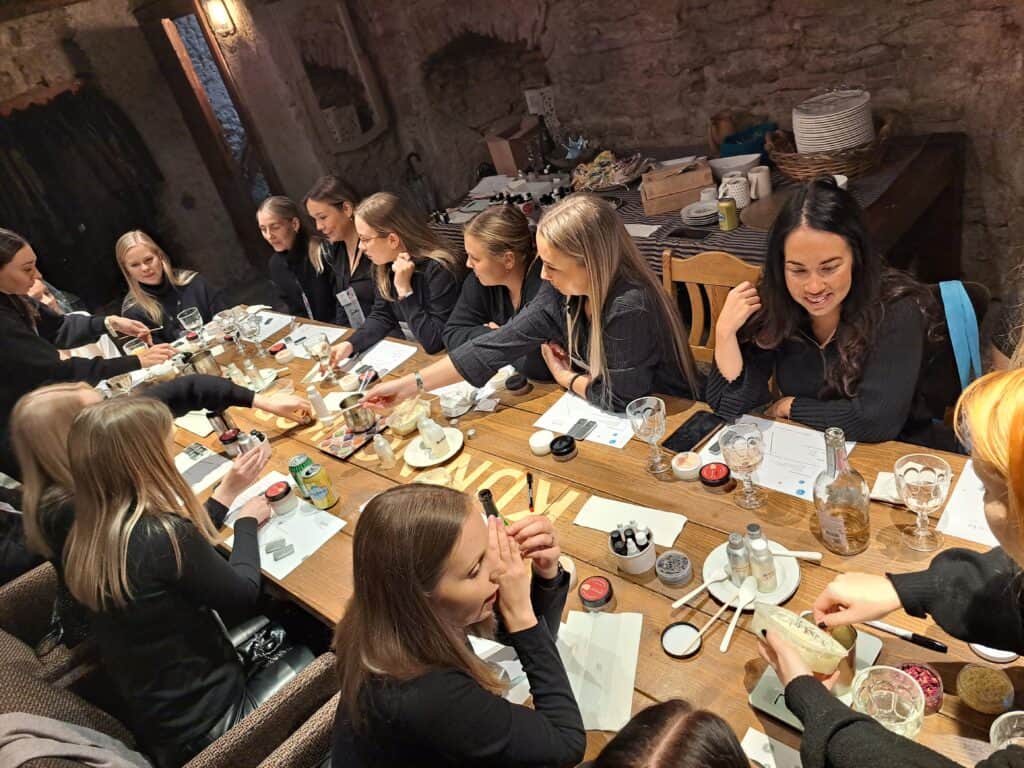
You can mold wonderful things out of marzipan. My dear aunt Ede from Saaremaa has been molding marzipan cake decorations and all sorts of figures for several good decades. I also went to her to learn how to mold simpler figures, and that’s how the marzipan workshop found its way into Örreke’s selection.
As we know, marzipan consists of almond flour and powdered sugar. The more almond flour there is, the higher the quality of the marzipan. Unfortunately, it’s actually better to mold with marzipan that has equal parts almonds and sugar. It’s easier to mold with colored marzipan, because painting marzipan is an art in itself.
As Estonians, we like to think that we invented marzipan back in the Middle Ages, when an apprentice pharmacist named Mart mixed together a pleasant-tasting medicine called Martzipanise at Tallinn’s Town Hall Pharmacy. You can listen to what Mart’s marzipan contained and how the medicine affected the Tallinn alderman in the ERR radio play: Jaan Kross’s “Mardi leib” (Mart’s Bread).
In reality, marzipan is an oriental treat, and the history of its preparation dates back 2,000 years.
NB! Before you start molding the figures, wash your hands thoroughly and dry them well!
Knead the marzipan between your fingers to make it softer. When the marzipan starts to shine a little, it’s the right time to start molding.
Marzipan sticks to your fingers, but I still recommend that you don’t use rubber gloves. You feel the marzipan better without gloves. Molding is made easier by using cling film, through which it’s much easier to press the marzipan wider. You’ll also need cling film when molding a rose.
1. Molding a larger chick
Make two yellow balls, one larger (body) and the other smaller (head). From the larger ball, press out a tail with a sharp end for the chick’s body. Place the smaller ball as the head.
Make two small red balls. Mold a beak from one and a small crest from the other. Add blue edible pearls for eyes.
2. Molding a small chick
Make one yellow ball and two very small balls for wings. Press the small balls into triangles and attach them to the sides of the larger ball. Make a beak and a small tuft for the chick from red marzipan. You can make the eyes from either black marzipan or edible pearls.


To mold a bunny, you need one larger ball (body) and one smaller ball (head), and then four balls of the same size (paws, ears). For the pink ears and nose, mix together a little white and a very little red marzipan.
Place two small balls under the body for paws and press a few stripes onto the paws with a toothpick. To make an ear, make a long teardrop shape from a white ball and a slightly shorter teardrop from the mixed pink marzipan. Place the pink teardrop in the center of the white one and press it into an ear. Do the same for the second ear and attach both ears to the head. Add a pink nose and small black eyes.
You can get a carrot by mixing yellow and red and molding it into a sausage shape with a sharp end. Poke the sausage a bit with a toothpick and make green leaves for it too.


For the grass, take green marzipan and roll a ball. Place the ball on the base, cover it with cling film, and press and stroke it gently to make it larger. Marzipan loves to be stroked!
For the little flowers, mix different colors together and make one pea-sized ball for each flower. Press the ball slightly wider through the film and use a toothpick to push 4 notches into the flower (from the outside in). Place a heart made of yellow marzipan in the center and lift the flower petals up a bit.
Place the flowers, chicks, and bunny on the grass, and your grand Easter cake decoration is ready.


To mold a rose, you need six balls of exactly the same size. Make small discs from each ball by pressing them with the help of cling film. If you make the edges of the discs thinner, the rose will look especially beautiful. Roll the first disc up. This creates a flower called a calla lily. This “calla” will be the heart of your rose, around which you will start placing the other discs. Press the discs together only at the bottom, leaving the top open. Place each subsequent disc with a slight overlap on the previous one. Once all six discs are placed around the heart, you can cut off the elongated back end. Place the rose on the grass and decorate with edible pearls.


Check out how to mold marzipan figures in Örreke’s tutorial video.
You can also buy a marzipan molding kit from Örreke’s e-shop.