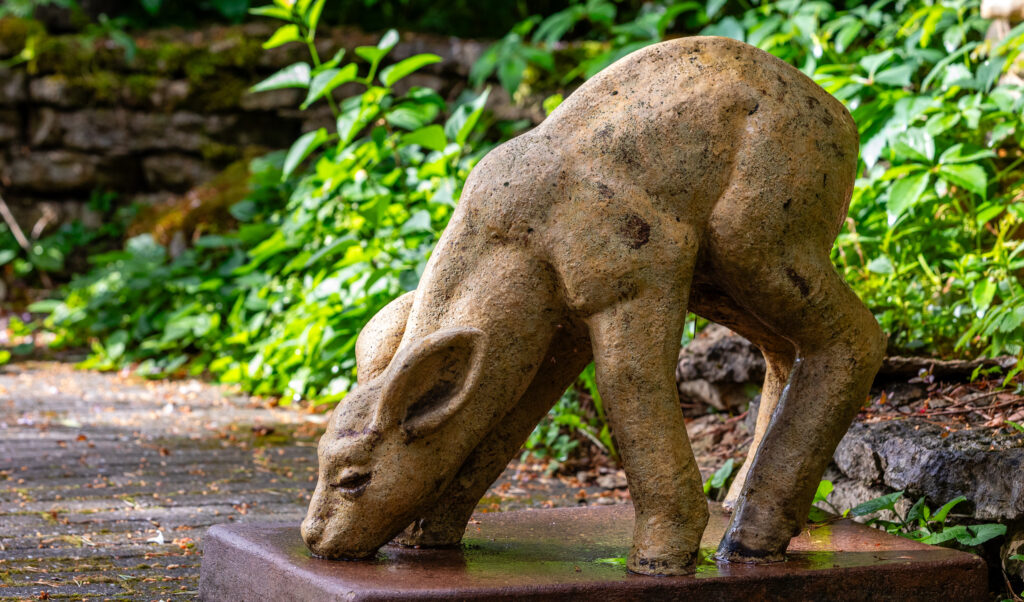

“If paintings decorate the walls inside, then garden sculptures decorate gardens and parks” – so said sculptor Ellinor Piipuu, whose works are beautifully displayed by her grandson’s family in her former Nõmme home studio garden.
Kadrin, the wife of the artist’s grandson, remembers this sentence as we discuss why a wave of sculptures appeared in Estonian home gardens in the 1960s. Back then, small round or rectangular ponds were also popular in private gardens, with figures placed among the plants nearby. Sculptures from this period have also survived as mood-setters in city parks.
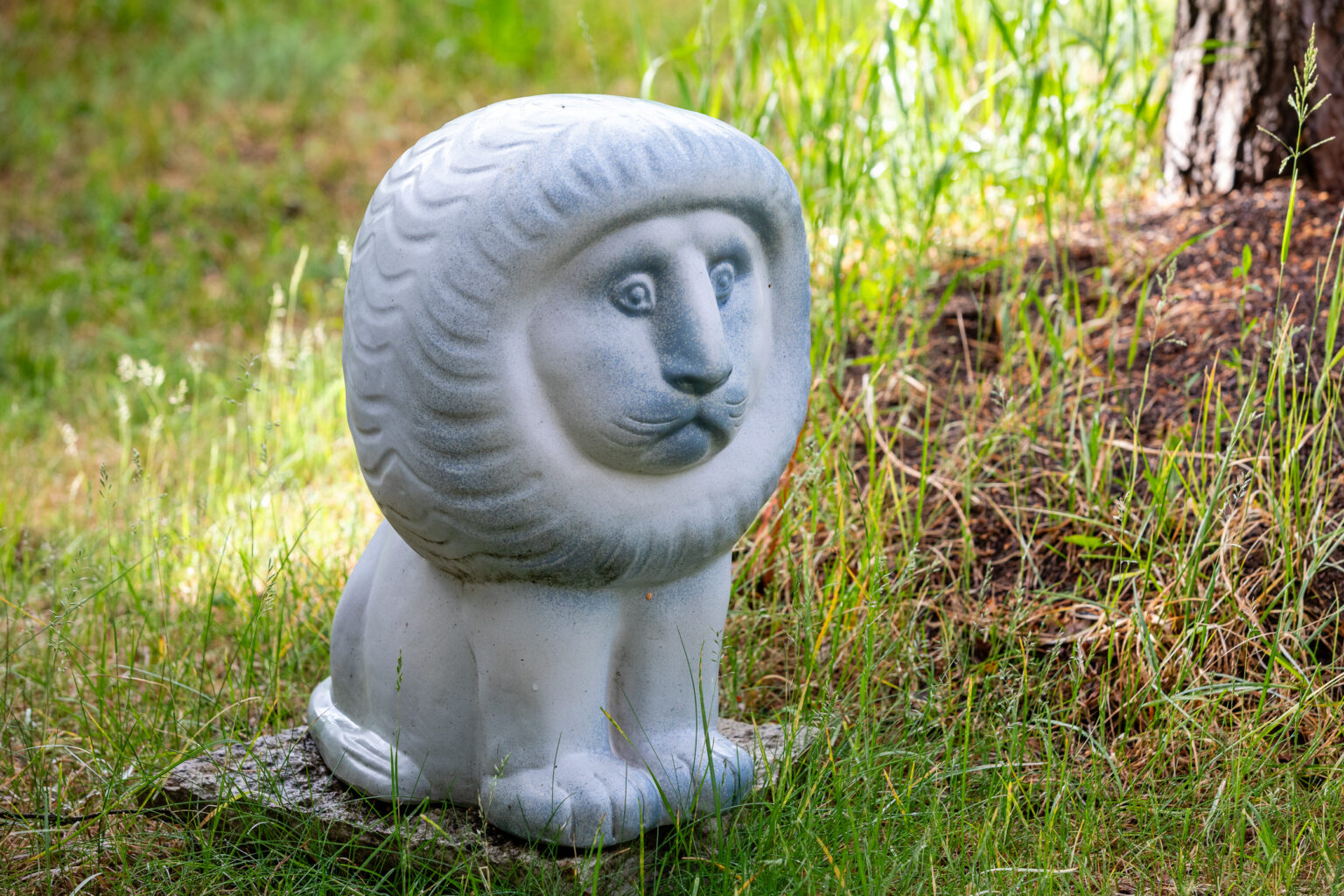
In the garden of one of the founders of Estonian garden ceramics, her creations remain just as the sculptures were originally placed in the pine-covered area or at the edge of the lawn in front of perennials. Peonies are currently blooming in the background.
“A penguin, a goat … birds added in the late 1980s. The front garden has always belonged to the sculptures, while the fruit and vegetable garden was next to it,” Kadrin says, showing black-and-white photos from the family album.
The pond, around which some of the works were clustered, is gone, and the house has also undergone a modern rebirth. Today, the focus of the outdoor area is more on being a decorative and relaxing garden.
“Ellinor came to live here in 1953, but they say there was a butcher shop on the plot during the first independence period,” Kadrin says of the family home located near Hiiu School. You can listen to Mark Soosaar’s conversation with the artist in the garden, accompanied by birdsong, from May 1979 in the radio archives: “An evening in the artist’s studio. Ellinor Piipuu” (arhiiv.err.ee).

“Ceramics fit into a garden much better than cement, cement figures, or cement vases. It is close to nature and its color tones also blend well with the colors of nature. Granite, of course, is also very suitable, but granite is so expensive that not everyone can afford it,” the artist says in the audio tour.


While walking in Nõmme and looking at gardens, the family occasionally finds Ellinor’s work. Once, however, Kadrin went to lead a craft workshop at a kindergarten in Õismäe and encountered Ellinor Piipuu’s lion sculpture there. It was said that when the kindergarten opened in the 1960s, two lions were gifted to guard it. Since one has not survived, the other was brought indoors. Another time, while sitting in a cafe in Lohusalu, the family saw a sculpture with a familiar style on the fireplace. They looked underneath, and it was indeed Ellinor Piipuu’s work. “They said someone had brought it there from an old summer cottage. Ellinor’s summer studio was also located in that area.”
A very exciting meeting will take place for the family in the USA while this magazine is going to print. The artist’s sister lived there, and Ellinor occasionally sent her works to her. Now the family is traveling to the small town of Kirksville in Missouri to bring back the creative heritage from one of the nieces. “We don’t know exactly what awaits us, but there are about twenty works in total, larger and smaller. We’ll bring back as much as we can ourselves, the rest will have to be shipped.” One life-sized female figure was made by Ellinor at her sister’s place. The model was the same niece where the works are now located.


Ellinor Piipuu and her grandson’s family garden in Nõmme, Tallinn, can be visited by appointment.
Kadrin’s contact details can be found on the craft and DIY workshops page at www.orreke.ee. It’s also worth keeping an eye on Nõmme’s open gates events, when the garden is sometimes opened for tours and as a home cafe.
ELLINOR PIIPUU 18.10.1913–05.04.2006
One of the founders of professional ceramic art in Estonia. She was the first to bring a freer approach to form in post-war ceramic art. Her favorite field remained sculpture, ranging from atmospheric small figurines to decorative garden sculptures. She studied ceramics and sculpture at the State Art School. She began her creative career in the 1930s and dated her last work in 1999. Her work reached audiences through numerous applied art exhibitions and several solo exhibitions, as well as through the production of the ceramics studio of the Art Products Combine.
Source: obituary from the art unions
Text: Malle Pajula
Photos: Priit Grepp
Originally appeared in: Kodukiri 7, 2024